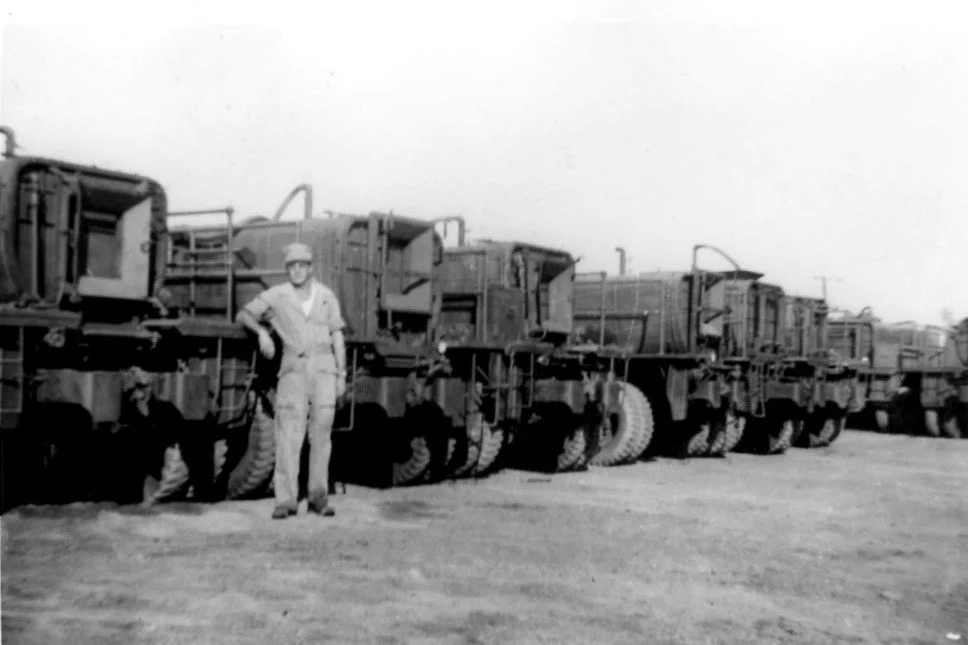
Sgt Roger Thomas with “Deuce and a half” chemical handling trucks
I greatly enjoy finding photos that show daily life at Ondal Army Air Force Base, where my father served. Located 180 km (110 miles) northwest of Calcutta, Ondal is best known for its two non-secret roles in uncrating airplanes that arrived in the CBI by ship and providing heavy maintenance for planes that were either bombing Japanese targets in Burma or flying cargo over the Hump. Details about the base’s third role as the site of Ondal Advanced Chemical Depot remained secret for over six decades until 2009, when they were declassified under a broad Executive Order from President Obama. Ondal was America’s central toxic chemical depot for the CBI, responsible for a stock of about 100,000 bombs filled with mustard agent, phosgene, cyanogen chloride and other toxic chemicals. The bombs were ready for what President Roosevelt had promised would be “retaliation in kind” if Japan had resumed its earlier use of similar munitions in China. Although never used, some of these bombs were positioned on the flightlines of the four B-29 bases in India, from which the U.S. launched its first direct strikes against the Japanese home islands since the Doolittle Raid. My father, Sgt. Roger Thomas, served late in the War with the 771st Chemical Depot Company, 305th Air Service Group. A civilian plumber, the Army trained him to be a “Toxic Gas Handler” and a “Decontaminating Equipment Operator.” By the time he arrived in India, the primary activity at Ondal was transporting unwanted toxic munitions to the port at Calcutta, from where they were dumped into the Bay of Bengal. Some munitions (particularly leak-prone M47A2 bombs filled with mustard agent) were instead buried at Ondal.
“Deuce and a half” (CCKW) trucks, like those in the photos, were a common sight during WWII. The truck at the top of the photo of the filling station was configured to carry fuel, while the truck being refueled below it had a more generic configuration. The trucks shown with my father in the other photo were configured to transfer bulk liquid mustard agent, but they might well have taken their turn at the same filling station. Racial segregation during the Second World War ensured that “Negro” soldiers like those shown operating this filling station for the 305th Service Group were separated for housing, meals, recreation and most other activities, but fueling his truck might have been one of the occasions when my white father interacted on the base with African American soldiers.
The filling station photo is “NAID: 204963961,” provided to the U.S. National Archives by Fold 3. The photo of my father and the chemical trucks is from his collection and was likely a security violation when he took it.