Pvt. DeArmond, Col. Morgan, and Gen. Benedict Arnold
This is the second post on Pvt. Thomas DeArmond’s service as a rifleman during America’s Revolutionary War. As much as I want to focus on Pvt. DeArmond and other enlisted men, this post on the Battle of Saratoga—correctly known as “The Turning Point of the Revolutionary War”—also requires attention to the high-ranking officers who gave the orders on how and where DeArmond fought. Your comments are welcome, but any that are inconsistent with a civil and fact-based discussion of our true Revolutionary War history will be deleted. Please consider reading some of the abundant resources on this topic, a few of which are listed in the first comment.
Colonel Daniel Morgan was the Commander of the Rifle Regiment in which Pvt. DeArmond served, issuing orders that flowed quickly through Company Commander Gabriel Long and his NCOs to DeArmond and the other riflemen. General Benedict Arnold is now remembered primarily as the arch traitor of the Revolution, but at Saratoga, he was a genuine hero. Arnold was effectively in command of Morgan’s Regiment and the rest of the forces protecting the Continentals’ left flank. General Gates was the overall American commander in the battle, and General Burgoyne commanded the attacking force of British and Hessian Regulars and their Iroquois allies.
Daniel Morgan was an exceptional officer for the time, in part because his position was based almost entirely on proven ability as a battlefield leader. He was raised in a poor family and had no formal schooling. He learned to read and write as an adult and was self-taught in a wide variety of topics. He entered the military as a teamster for the British during the French and Indian War, and later established a successful freight-hauling business. He earned enough money to purchase a 225-acre farm in Virginia. Along with the farm, he owned 10 slaves. Before Saratoga, Morgan proved his leadership ability in the ill-fated American invasion of Quebec, and he proved his ability again later at the Battle of Cowpens. His soldiers respected him and his rough, frontier style, referring to him affectionately as the “Old Wagoneer.”
Initially, Benedict Arnold was closer to the typical model of an officer and a gentleman. His father was a successful businessman in the upper levels of Connecticut society, although the family fortunes began to decline as Benedict approached adulthood. His father’s alcoholism contributed to Benedict's being forced to leave private school and abandon his plan to attend Yale University. With assistance from his mother’s wealthy family, he established himself in business. By the mid 1760s, he owned both onshore businesses and sailing ships in the West Indies trade. His businesses were hurt by the British Sugar and Stamp Acts, and Arnold joined the Sons of Liberty. As war began in 1775, he was elected as a captain in the Connecticut Militia and soon rose to the rank of Major General in the Continental Army. He had strong supporters among his fellow officers but he also made many enemies, and he often expressed the view that others did not properly acknowledge his achievements.
As context for Pvt. DeArmond’s role at Saratoga, the essential facts of the battle are that Gen. Burgoyne’s army advanced south from Canada towards Albany, intending to split the colonies. By mid-September 1777, Burgoyne was short of supplies and had few options for getting more except by pushing on to Albany. Both Burgoyne and the Americans knew the British needed to break through to Albany before winter. Gen. Gates blocked the way with strong fortifications, wanting to force the British to attack head-on so the less-trained Colonial forces could fight from sheltered positions. Burgoyne was seeking a chance to destroy the Continentals as well as to reach Albany, and he hoped for the fighting to be bayonet-to-bayonet in open ground, where his disciplined troops could proceed in well-organized lines.
To Burgoyne, the 500 Iroquois on his side were useful as scouts and for harassing the colonial forces, but he did not expect them to be decisive. For many of the colonial soldiers, the Iroquois were a familiar enemy. Standing behind fortifications and firing at British soldiers as they approached was undoubtedly a frightening prospect. Still, it may have been even more terrifying to anticipate large-scale fighting of the type that had flared for years along the frontier between Native Americans and settlers—fighting that included brutal atrocities on both sides. George Washington sent Morgan’s Riflemen to alleviate the colonial soldiers’ fears and to “fight the Indians in their own way.”
As it developed, Morgan’s 500 riflemen arrived with great fanfare, wearing buckskins and walking in disorganized lines. At about the same time, the Iroquois decided to leave the battlefield. A common American interpretation is that the Iroquois were too frightened of Morgan’s men to stay and fight. Another interpretation is that the Iroquois recalculated the likelihood that Burgoyne could actually assist in protecting their people from westward-moving settlers. In any case, the departure of the Iroquois left Burgoyne without the scouts he needed, and it left Morgan’s Riflemen without the opponent they expected to face.
The British began their assault on September 19th, approaching the American left flank at Freeman’s Farm. Gates was content to keep his army behind its fortifications and wait for the British to reach him. Arnold wanted to take the initiative, and Gates agreed reluctantly to let Arnold send Morgan’s Riflemen and a single company of musket-carrying infantry out beyond the fortifications to “investigate.” Soon, a few hundred riflemen and 200 musket-carrying infantry were engaged with several thousand British and Hessian regulars equipped with cannon. The Americans held the line long enough for Arnold to bring up his division of American regulars, resulting in an intense fight that lasted for several hours. There are different accounts of whether Arnold personally rode out to join in the fight at Freeman’s Farm, but Morgan was undoubtedly in the middle of it. Whether from the rear or nearer the fighting, Benedict Arnold was directing the movement of the Americans. Taking advantage of his riflemen’s unique ability, Morgan ordered his men to aim beyond the British front-line soldiers and to target the very brightest of the British uniforms. The Americans were eventually forced to withdraw to their fortifications, but they suffered only about 300 casualties compared to 600 for the British. Because of the riflemen’s accurate fire, many of the British losses were officers and artillerymen.
Gates was so upset with Arnold’s disobedience at Freeman’s Farm that he relieved him of command. Despite that order, when the British attacked again at Bemis Heights three weeks later, Arnold rode out and took active command. Morgan’s men again fought as they had been taught and ordered, taking shelter behind trees and aiming carefully, and again a disproportionate number of the British casualties were officers. The popular British general, Simon Fraser, was among the fatalities. Under Benedict Arnold’s unauthorized command, Bemis Heights was a clear American victory. Benedict Arnold was seriously wounded in his leg at Bemis Heights, but continued to help lead the fight.
Recognizing that he could neither retreat nor reach Albany, Burgoyne surrendered on October 17th. Burgoyne’s surrender came just in time to offset news that the British had occupied the American capital at Philadelphia three weeks earlier. The Continental victory at Saratoga helped turn public opinion in America and Europe toward the belief that the colonists might actually defeat the world's most powerful military and achieve independence.
One area of continuing debate is the shot that killed Simon Fraser. There is an often-repeated story that Morgan specifically instructed Timothy Murphy to take the shot with his double-barreled rifle, although the story seems backed by little evidence. There is even a slight chance that Pvt. DeArmond fired the shot that killed Fraser, but, in truth, it is not even certain that DeArmond fought at Saratoga. He was undoubtedly under Morgan’s command at the time, but he might have been one of the many soldiers who were too ill to fight after their fast march from near Philadelphia.
A more general question concerns the effectiveness and even the ethics of using rifles to target officers. After the victory at Saratoga, the Continental Army marched to winter quarters at Valley Forge and also marched to its answer regarding European- vs. guerrilla-style war. Valley Forge was a winter of hardships, but also an important opportunity to train for the years of war still ahead. Pvt. DeArmond and the rest of the riflemen went with them and continued outside the main encampment to play a vital role as scouts, foragers and skirmishers. Within the camp, training followed European traditions.
Gate’s strategy of waiting behind fortifications might have worked, but Burgoyne’s plan to turn the American left flank might also have worked. It is entirely possible that without Arnold’s initiative and vigorous leadership, the Continentals would have lost the Battle of Saratoga. The British would then have succeeded in reaching Albany and securing the supplies needed to further disrupt the colonies. Almost simultaneously, on September 26, 1777, the British occupied the American capital at Philadelphia. Two major defeats in the autumn of that critical year would have made American independence far less likely. Benedict Arnold was a true hero at Saratoga, one whose personal bravery and sacrifice made a real difference to America’s future. Publicly acknowledging the contributions of a figure such as Arnold, however, can be challenging. One solution in 1887 was to erect a monument near the site of the battle that shows Arnold’s boot but does not mention him by name.
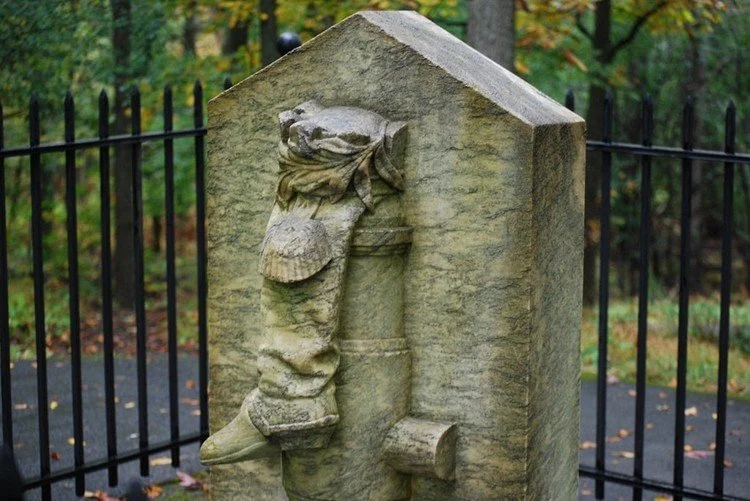
Boot Monument within Saratoga NHP, NPS Photo
Another controversy regarding the Battle of Saratoga concerns the treatment of prisoners. Gates was extremely generous in negotiating the terms of surrender, formalized as the “Convention.” British officers were accorded full respect, and regular soldiers were promised they could return quickly to England “on condition of not serving again in North America.” Six thousand captured officers and soldiers and 600 camp followers marched to Boston, from where ships were to take them home. The Continental Congress was so upset with Gates’ leniency toward the prisoners that they refused to abide by the agreed terms. Neither side, however, wanted to pay for the upkeep of what was called the Convention Army of soldiers forbidden to fight. The number imprisoned at Charlottesville, Virginia and elsewhere decreased steadily through prisoner exchanges and frequent escapes. When the War finally ended six years later, many of the British and Hessian prisoners decided to stay in America and make new lives for themselves. Many Americans today have an ancestor who fought at Saratoga on the British side.